


On 20 November 2026, the World Meteorological Organization (WMO) put out a project update with a plain message: El Niño is "firmly established" and is expected to strengthen further through February 2027. Governments, communities and partners are now trying to get ahead of the damage.
That update makes more sense when you read it next to WMO's State of the Climate Update 2026, released on 9 November, the first day of COP31 in Antalya. The two documents together tell one story. The planet was already very hot. A strong El Niño is now arriving on top of it. This explainer walks through what happened, why it matters, what happens next and what it means for India.
Quick read
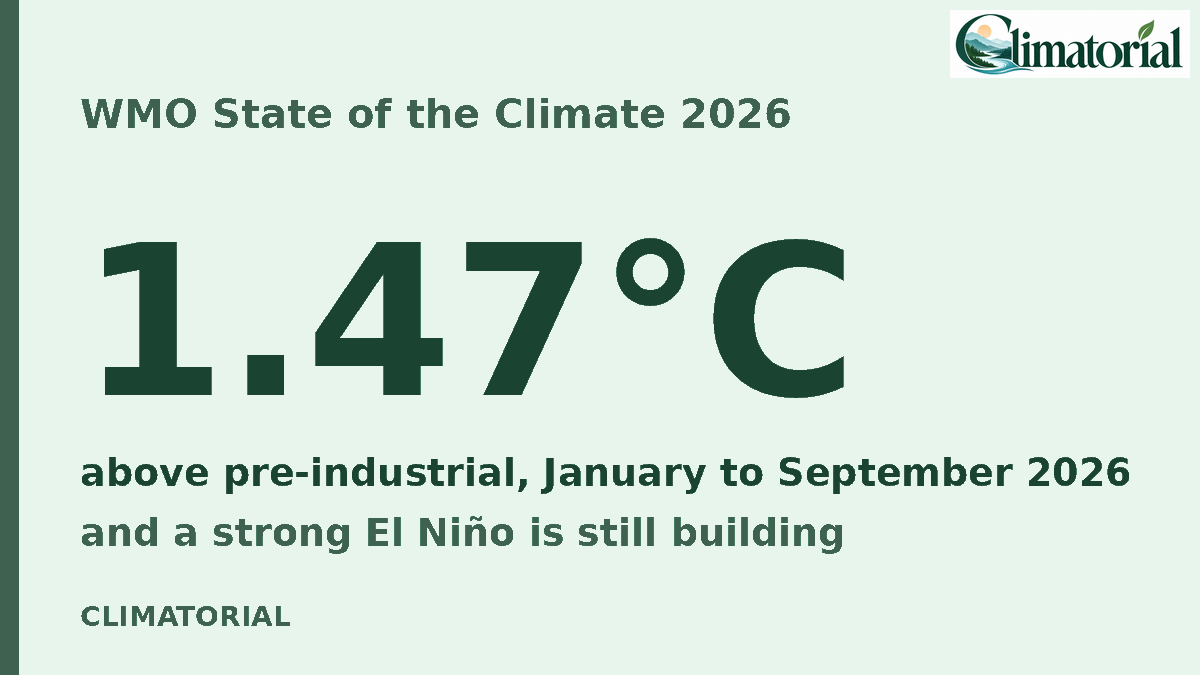
- 1.47 °C: global temperature above the 1850 to 1900 average, January to September 2026.
- 146.5 million: people in India exposed to extreme heat in the April 2026 heatwave, per WMO's estimate.
- 56 to 136: countries reporting multi-hazard early warning systems, 2015 to 2025.
- Feb 2027: El Niño is expected to keep strengthening until at least then.
What happened
There are two pieces here, and it helps to keep them apart.
The first is the State of the Climate Update 2026. WMO says the past 12 years have each been the warmest on record, and the past four years (2023 to 2026) are the top four. The January to September 2026 average was 1.47 °C above the 1850 to 1900 level, give or take 0.13 °C. That is based on nine international datasets. It is close to the full-year figures for 2025 (1.43 °C) and 2023 (1.46 °C), and below the 2024 record of 1.55 °C.
The second is the 20 November project update. WMO says it has stepped up support across its 194 Members. It describes work in Cabo Verde, in Cambodia and Lao PDR, across the Caribbean and across Pacific island states, all aimed at getting warnings turned into action before El Niño's impacts land.
How warm was each year? Global temperature above the 1850 to 1900 average (°C)
| 2023 | 1.46 | |
| 2024 (record) | 1.55 | |
| 2025 | 1.43 | |
| 2026 (Jan to Sep) | 1.47 |
Source: WMO State of the Climate Update 2026 (9 November 2026). Bar lengths are drawn against a 1.6 °C scale. The 2026 figure covers only nine months.
Why it happened
Start with the ocean. WMO says the ocean absorbs 90% of the excess heat trapped by greenhouse gases, and that 2026 is on track to be the tenth successive year of record ocean warmth. Ocean heat content in the upper 2,000 metres was the highest on record in 2025 and kept rising in 2026, based on preliminary data up to July.
Now add El Niño. Early in 2026, La Niña conditions had a small, temporary cooling effect. El Niño then developed and reversed that, intensifying since August. WMO expects it to be the strongest on record by December. Secretary-General Celeste Saulo put the logic simply: El Niño does not create new heat, it releases heat from the ocean, and this ocean is the warmest ever measured, so there is more heat to release.
The gases behind it keep climbing too. Carbon dioxide reached about 426.8 parts per million in 2025, up 53% from 1750. Methane reached 1,948 parts per billion, up 167%. Nitrous oxide reached 339.1 parts per billion, up 26%.
How much greenhouse gases have grown since 1750 (% increase, 2025 levels)
| Methane | 167% | |
| Carbon dioxide | 53% | |
| Nitrous oxide | 26% |
Source: WMO State of the Climate Update 2026 (9 November 2026). Bar lengths are drawn against the largest value, methane at 167%.
What the report says El Niño will do
WMO calls the current El Niño a "risk multiplier". Heat, drought and heavy rain can all get worse, depending on the region. The report lists heat-related illness and deaths, wildfire smoke and poor air quality, malnutrition and food insecurity, injuries, and changing risks of water and vector-borne diseases such as cholera, malaria and dengue.
It adds that, for the first time, the World Health Organization has classified the anticipated health impacts as a health emergency. Agriculture is flagged too, especially where food insecurity is high and farming depends on rain.
One number deserves a pause. El Niño typically adds around 0.1 °C to 0.2 °C to the global annual average, and its biggest effect usually shows up in the year after it develops. WMO says the final 2026 figure will probably end up above the January to September average. That points towards 2027 as the year when the full punch lands.
How it goes forward
The final State of the Global Climate 2026 report is due in March 2027. It will fold in data from dozens of national weather services and regional centres, and, unlike the November update, it will capture the recent impacts of El Niño.
In the meantime, the 20 November update shows what preparation looks like on the ground:
- Cabo Verde: its meteorological institute launched a new website, improved data exchange and began sending forecasts and alerts in the Common Alerting Protocol format. The country also validated a national roadmap for multi-hazard early warning.
- Cambodia and Lao PDR: both are drawing up water management plans and national drought action plans for 2025 to 2030. Seasonal monsoon forums were held in May 2026, with a dry-season forum planned for November 2026.
- Caribbean: forecasters trained in impact-based warnings, and 16 national weather services were trained on data-sharing systems.
- Pacific: support for climate outlook forums and drought management plans. In Vanuatu, community water tank projects were delivered ahead of schedule across Epi, Ambae and Santo islands.
WMO's own summary is that forecasts alone do not save lives. Weather services have to work with disaster agencies, sector ministries, humanitarian groups and local communities so that a warning becomes a decision.
What it means for India
The WMO update of 20 November does not describe any India-specific project. The India links come from the 9 November report, and they are sobering.
WMO estimates that 146.5 million people in India were exposed to extreme heat in an April 2026 heatwave. It also notes that a Himalayan glacier collapse and the flash flood that followed in late August killed more than 1,300 people and badly hit Nepal's economy. The report points to compound risks in "fragile, warming high-mountain terrain", which is the same Himalayan belt India shares.
On the health side, the report's warning about heat, poor air quality and water-borne and vector-borne disease is general, not India-specific. But it reads directly across to Indian summers and monsoons, where all of these already show up.
There is also a COP31 thread. India's opening statement at Antalya, delivered by MoEFCC Secretary Narendra Bhooshan, asked for a fair, equitable and ambitious outcome and stressed multilateralism and equity, according to a government statement of 10 November. A record-hot year with a strong El Niño is the backdrop to those talks. We did not find the final COP31 outcome text on an official page in time for this piece, so we do not describe it here.
Climatorial view
This is our reading, not a WMO finding.
The most useful line in WMO's package is the boring one: early warning systems are spreading, from 56 countries reporting multi-hazard systems in 2015 to 136 in 2025. A hotter, stranger 2027 is not something any country can stop. How well it is warned about and prepared for is something countries can change.
For India, the question to watch is less "will El Niño be strong" and more "who gets the warning, in which language, and in time to act". The Caribbean and Pacific examples are about exactly that last mile. They are worth studying, and worth asking whether similar drought and heat plans exist at the district level here.
What to watch next
- WMO's final State of the Global Climate 2026 report, expected in March 2027.
- Whether El Niño peaks on the timeline WMO describes, strengthening through February 2027.
- Any official COP31 outcome documents from the UNFCCC.
Sources
- WMO press release: State of the climate in 2026 gives new meaning to phrase "off the charts" (9 November 2026)
- WMO project update: WMO projects strengthening El Niño preparedness and early action worldwide (20 November 2026)
- WMO: State of the Climate Update for COP31
- All India Radio / PIB: India reaffirms commitment to climate multilateralism at COP31 (10 November 2026)
Cover image: Graphic: Climatorial


 Continue With Google
Comments (0)